
At this week’s tabling of budget estimates, Prime Minister Philip J. Pierre held up what he said was the 2025 Citizenship by Investment Programme (CIP) report, seven months after it was originally due, adding that its contents will be revealed at the next sitting of Parliament.
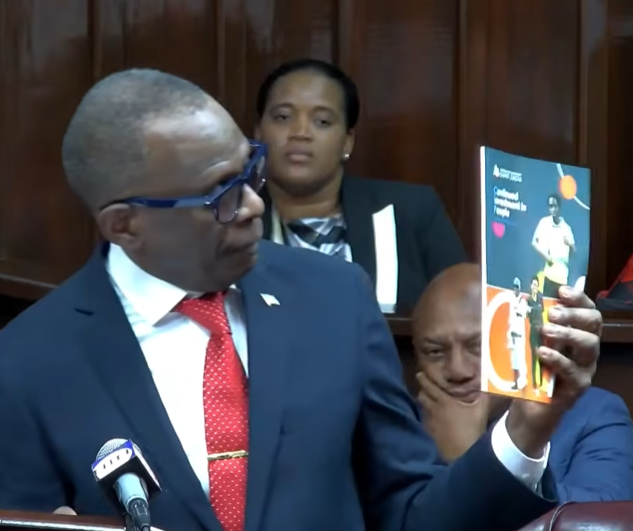
Amid the delay, speculation about the programme’s impact on Saint Lucia’s geopolitical status continues to fester.
In response to these uncertainties, opposition United Workers Party (UWP) leader Allen Chastanet, in a March 16 interview with St Lucia Times, again pressed the administration to release the report’s results.
“The report for 2025 has not been made public,” Chastanet stated, noting the inclusion of the 2023 to 2024 CIP report’s results in the UK’s Explanatory Memorandum, which outlined the rationale for introducing visa requirements for Saint Lucians. It drew a parallel between an increase in asylum seekers in the UK and the rise in the number of CIP applications.
Chastanet expressed regret over what he perceives as a lax approach to processing applications during the Pierre administration. He noted that fewer than 900 passports were issued during his entire administration, compared to more than 1 000 between 2023 and 2024.
“Questionable due diligence has been done on these persons, and therefore, we’ve become a substantial risk just like Dominica,” he stated.
The CIP unit, however, continues to maintain that due diligence processes have been adhered to. In 2023 to 2024, $133 100 000 was reportedly spent on due diligence fees.
On Monday, March 23, Resident British Commissioner Doyin Adele-Shiyanbola told St Lucia Times that prior to the UK’s decision, border security concerns “around migration issues, around the CIP programme, [and] around the abuse of the system” had come up during regular talks between the two countries.
She said that CIP programmes, in general, continue to be perceived as risky.

“We understand the value to Saint Lucia and its economy,” stated Adele-Shiyanbola. “But for the UK, it’s inherently quite high risk – and we’ve been very clear about that. We’ve had a really good, productive relationship with Saint Lucia, where some of our concerns have been addressed and we’re really grateful for that cooperation. We obviously look forward to continuing on that journey of working with Saint Lucia on reforms that are needed in the programme but just more broadly around the immigration policy and around obviously the asylum numbers that we’re seeing in the UK.”
However, according to Adele-Shiyanbola, the UK’s decision to introduce visa requirements for Saint Lucia was not made lightly. And while the CIP is generally seen as high-risk, the UK’s policy changes were more closely tied to the number of Saint Lucian nationals seeking asylum. Between January 2022 and December last year, 360 applications were made – a number considered high for Saint Lucia’s population size.
While a spike in asylum seekers parallels a spike in CIP applications and approvals, Adele-Shiyanbola said she could not detail cases in which asylum seekers holding Saint Lucian passports were also CIP holders or were Saint Lucian-born. Asylum cases, she notes, are handled confidentially.
She maintains that the core issue behind the visa restrictions is a desire to ease the burden that asylum applications place on the UK.
“For every application that we receive in the UK and those that particularly receive asylum support, it costs the UK taxpayer quite a lot of money, on average about £40 000 (EC$143 500) per application,” Adele-Shiyanbola said, noting that by the end of 2025, 222 nationals of Saint Lucia were receiving asylum support.
At home, the Saint Lucia government maintains their stance that the CIP is not linked to the UK’s decision.
“Why would the UK take a blanket approach to all Saint Lucians?” asked MP Richard Frederick, asserting that if CIP holders were the cause, there wouldn’t be a need to apply requirements for all Saint Lucians.
“I could tell you those persons who are probably accessing the UK that are holders of our passport through the CIP programme would be less than one percent,” Frederick asserted.
According to Adele-Shiyanbola, the UK remains open to continued dialogue with Saint Lucia as both countries work through the concerns raised.