
The United States-Israeli war on Iran and Tehran’s retaliatory strikes across the Gulf region have upended global financial and energy markets, raising concerns of a global economic crisis – and even of a recession.
Energy prices
Since the US-Israeli strikes on Iran began on February 28, Tehran has launched a wave of ballistic missiles targeting Israel, US military bases, oil depots and other infrastructure across the Gulf region.
Iranian attacks on several vessels passing through the Strait of Hormuz have also dramatically reduced traffic in the narrow channel, through which about 20 per cent of global oil and gas supplies transit. Iran also attacked fuel tankers in Iraqi waters.
All of this has combined to send oil prices soaring. According to Muyu Xu, a senior crude oil analyst at Kpler, liquified natural gas (LNG) prices have risen even more sharply – by almost 60 per cent – since the start of the war.
On March 2, QatarEnergy suspended its LNG production after an Iranian drone attack, straining the global LNG market. Qatar supplies 20 per cent of the world’s LNG.
Prices of refined products from petrol and gas oil to jet kerosene and fuel oil have also seen significant increases, and that trend is expected to continue if energy flows through the Strait of Hormuz remain largely shut, Muyu added.
According to a March 9 report by Neil Shearing and his team of economists at the global macroeconomic firm Capital Economics, if the conflict is short-lived and Iranian attacks on the Gulf countries and in the Strait of Hormuz cease, “oil and LNG prices would fall back sharply with the price of Brent crude reaching $65pb [per barrel] by the end of the year.”
But in case of a longer war, the report noted: “Oil prices would rise further during the conflict to around $130pb in Q2 [second quarter]. … Shipments through the Strait of Hormuz would resume in Q2 although prices remain higher than in the first scenario by year end.”
“Even if the conflict is contained to three months, we think Brent crude oil prices could rise to an average of $150pb over the next six months or so,” the economists forecasted.
Lower productivity
As import costs for energy-guzzling economies are rising, their economic productivity is also beginning to decline.
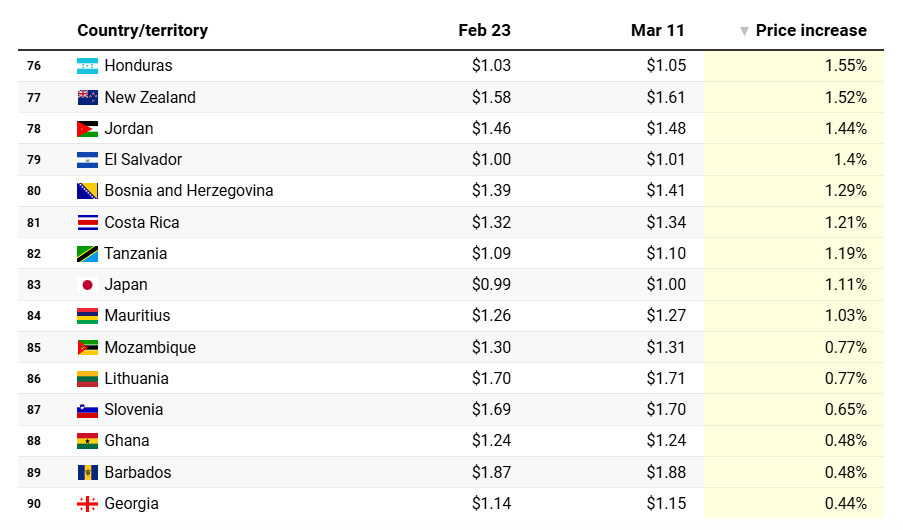
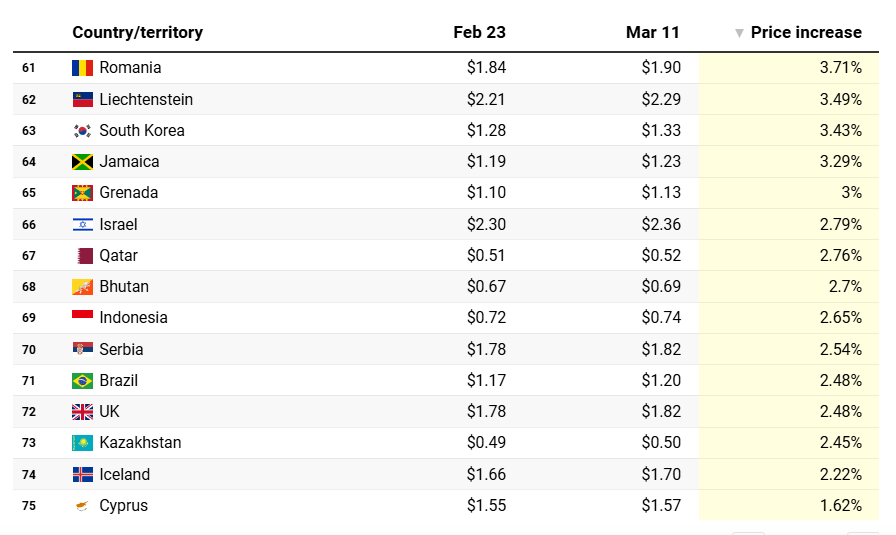
According to data analysed from Global Petrol Prices, a data platform that tracks and publishes retail energy prices across about 150 countries, at least 85 countries have reported increases in petrol prices since February 28. Some nations announce price changes only at the end of each month, so higher prices are expected for many others in April.
(insert gas price photos here)
So far, Cambodia has recorded the highest petrol price increase of nearly 68 per cent, rising from $1.11 per litre (a quarter of a gallon) of 95 octane on February 23 to $1.32 on Wednesday. Vietnam follows with a 50 per cent increase, then Nigeria at 35 per cent, Laos at 33 per cent and Canada at 28 per cent.
These price increases at the pump have led governments to take drastic steps to conserve fuel.
Pakistan has introduced a four-day workweek for government employees with 50 per cent of the staff working from home on rotation. Government offices in the Philippines have moved to a four-day workweek too. Thailand has made work from home mandatory for government officials.
Myanmar’s government has imposed a rule under which cars may drive only on alternate days. In Sri Lanka, vehicle owners must register online to buy fuel, then use a QR code at the pump to purchase petrol or diesel. The move is aimed at regulating how much each individual consumer buys.
All of this, economists said, impacts the productivity of economies. They manufacture less and deliver fewer services, further deepening the economic crisis.
Inflation and stagflation fears
The International Monetary Fund’s managing director, Kristalina Georgieva, has warned that if the war is prolonged, it poses an inflationary risk on the global economy.
“We are seeing resilience tested again by the new conflict in the Middle East,” Georgieva said on March 9 at a symposium hosted by Japan’s Ministry of Finance while warning policymakers to be prepared for it.
Oil price shocks have also historically summoned stagflation – increasing inflation coupled with rising unemployment. Economists pointed to the crises of 1973, 1978 and 2008 as evidence that every significant spike in oil prices has been followed in some form by a global recession.
Frederic Schneider, a nonresident senior fellow at the Middle East Council on Global Affairs, warned that debt-ridden Global South countries may face a debt crisis if interest rates are hiked in the Global North to combat inflation.
Travel and aviation impacts
The war has not only sent oil prices surging but has also upended global travel, pushing airline ticket costs on some routes sky-high.
Jet fuel prices, which were about $85 to $90 per barrel before the attacks on Iran, have soared to $150 to $200 a barrel, New Zealand’s flag carrier said last week.
Several Asian and European airlines, including Lufthansa and Ryanair, have oil hedging in place, securing a part of their fuel supplies at fixed prices. Oil hedging is the process of locking in the price of oil to buy or sell the commodity in the future.
Flights from Asia and Australia towards Europe and the US have also been taking longer flights to avoid the Gulf due to airspace closures in the region. This has further bumped up airline ticket prices.
Schneider noted that the airline rerouting is not good news for European airlines, which are already shut off from Russian airspace, making flights to Asia even longer and costlier.
“This crisis could also spill over into the rest of the year with a dampened tourism outlook and a potential cost-of-living crisis,” he said. (Al Jazeera)




It has been said “that quantity has a quality all its own.”
This article is the perfect object lesson for explaining the above quip: It demonstrates the lowest quality of journalism practiced at Al Jazeera, and at the same time, demonstrates the highest quality of stenography practiced at St. Lucia Times!
Here is an analysis that exposes the US empire as a paper tiger, in relation to the prosecution of modern warfare; analysis which will never be forthcoming from the presstitutes in western mainstream media:
The New Normal: Policy Tensor Special (Anusar Farooqui) – TIO Talks 50
https://www.youtube.com/watch?v=cXdE8XuQrd
I’ve never built the habit of criticizing without offering solutions: Here is what real journalism and analysis looks like outside the chaff obtained from mainstream media:
Geopolitical Economy Hour: War On Iran, World War III or Imperialism’s Last Stand? w Michael Hudson
https://www.youtube.com/watch?v=9Hwtm0V1kZc
Now, here is a reality-based discussion of the impact of the Iran war, particularly the role of media in objectively analyzing & reporting events to consumers:
The Week the Empire Fell (Anthony Moretti) – TIO Talks 49
https://www.youtube.com/watch?v=UDNAp12uSx8