
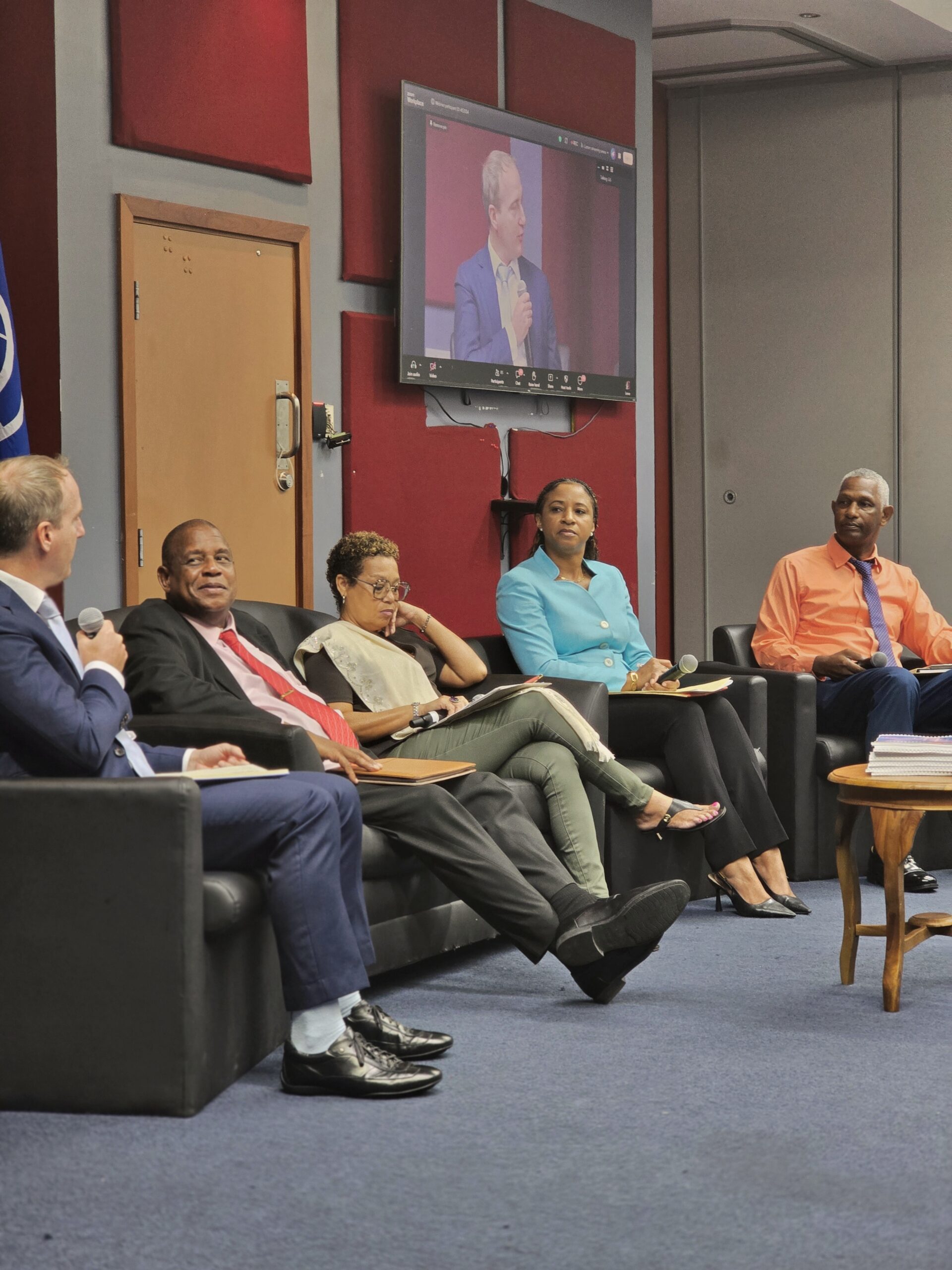
Well-known activist and president of Raise Your Voice Saint Lucia, Catherine Sealys, on Monday pressed a panel with representatives from the Ministry of External Affairs and law enforcement for answers regarding the recent remanding of Haitian migrants at the Bordelais Correctional Facility.
Sealys has been vocal about what she describes as inconsistencies in the treatment of different migrant groups. Ahead of Monday’s media briefing for the Draft National Gender-sensitive Migration Policy, the activist took to social media to say that Raise Your Voice Saint Lucia is called upon by immigration, police, social services and home affairs agencies to lend support in cases where “undocumented, trafficked, or otherwise in vulnerable situations” immigrants are Caucasian. However, she argued that “when the immigrants in question are Black Haitians, no such NGO is contacted”.
During the briefing, Sealys stated: “We are inundated every day from immigration, from home affairs, from major crimes, from everybody – ‘Can you help this person, can you help this person?’ – but when 28 Haitians landed here, nobody called us.”
Regarding the Haitian migrants in question, police informed St Lucia Times that the adults in the group were charged with illegal entry and later remanded to the Bordelais Correctional Facility. While declining further comment, police also confirmed that children were included in the group, and they were “doing okay”, and not taken to prison with their parents.
Southern Divisional Immigration Supervisor, Inspector Ken Charlery, who was part of Monday’s panel, responded to Sealys, saying: “…At this time, we’re guided by the Immigration Act and therefore, when we are faced with situations relating to migrants, that is the legislation that guides our operation.”
Charlery, who was consulted during the development of the new migration policy, admitted to sharing Sealys’ concerns, particularly after being involved in the policy development process. However, he reiterated that authorities acted within the scope of existing legislation.
“The act does make provisions that if there’s an investigation and there’s need to deem an individual a prohibited migrant, there is provision for them to be housed at a police station or the prison. That is what we currently have in our legislation,” he stated.
Noting that Saint Lucia is not a signatory to the 1951 Refugee Convention or its 1967 Protocol, and therefore does not have a formal process in place for determining refugee status, Sealys also seized the opportunity to highlight the need for policies that address humanitarian concerns pertaining to migration.
Legal Officer at the Ministry of External Affairs, Aiasha Jn Baptiste, said the ministry is looking to address the issue.
“…We are looking towards the Refugees Convention. It is a very important one as you stated regarding issues like the 28 Haitian nationals, so thank you for your participation and your comments,” she said.
Saint Lucia’s Ambassador for Diaspora Affairs, Julian Dubois added: “It brings to the fore the importance of what we’re doing now, you know, the necessity for this policy with buy-in from all agencies and a whole-of-government approach. So hopefully, all agencies could keep their hands on deck and realise that it’s a sad situation.”
The Draft National Gender-sensitive Migration Policy will be taken before Cabinet before final decisions are made on how and when it will be implemented.


This lady is being disingenuous. Call her about what? “The group were charged with illegal entry” which means they entered the country through the “back door” without proper or no documentation. Should they have called her to house these persons at her house or is she suggesting that the people of St. Lucia should host them at their homes? To my knowledge, illegal entry is against the law . . . it is a crime. Therefore, for breaking the law, they are being housed at the prison. “The children are “doing okay” (her words) which means the authorities were given due consideration.
Of course, I have strong disdain for how Caribbean countries treat Haitians and I will welcome them with open arms if they go through the process. However, I will never pander to lawlessness just because . . .