
By Keithlin Caroo-Afrifa
A recent St Lucia Times article reported that, according to data from the Food and Agriculture Organisation (FAO), Saint Lucia ranks sixth in the world for pesticide use intensity.
It was a headline that was always going to get people’s attention. Within hours, the comments began pouring in.
“This is why so many people have cancer.”
“The farmers are poisoning us.”
“I’m going to reconsider buying local.”
Reading those comments, I didn’t feel angry. I felt sad. Because behind almost every one of them was the same emotion: fear. People are trying to feed their families healthier food. They’re choosing local fruits and vegetables because they believe they’re making better decisions for themselves and their children. Then a headline like this appears, and suddenly that confidence begins to disappear.
I understand that fear. If I were simply reading the headline, I might have had questions too.
But before we blame the farmer, can we pause for a moment? Because this story is much bigger than a statistic.
The FAO figure raises important questions. It should encourage us to think seriously about pesticide use, food safety and public health. Those are conversations we absolutely need to have. But one statistic cannot tell the story of an entire agricultural sector.
It doesn’t tell us which pesticides are being used, on which crops, under what circumstances, or what alternatives farmers have available. Nor does it distinguish between highly intensive farming and the thousands of small-scale and diversified farmers who make up so much of our agricultural landscape.
Statistics should begin a conversation, not conclude one.
What worried me most wasn’t the headline. It was how quickly the conversation became, “The farmers are poisoning us.”
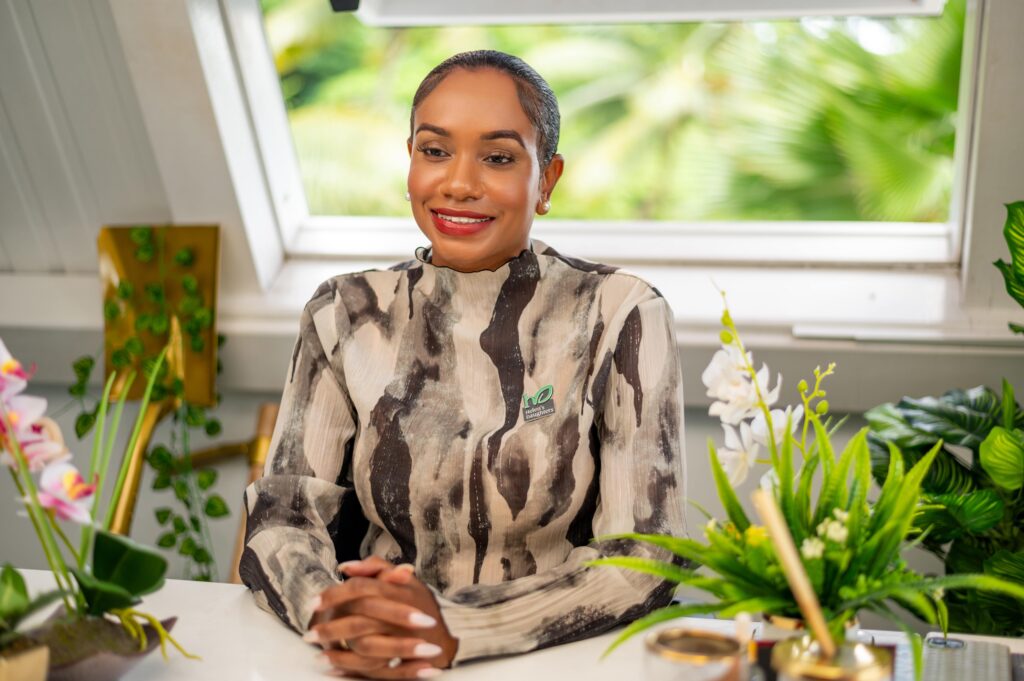
I’ve spent the last decade leading Helen’s Daughters, a regional nonprofit that works alongside women farmers across the Eastern Caribbean. Through our Ag-cademy, FarmHers Markets and community programmes, I’ve had the privilege of spending time in farms, kitchens and classrooms with hundreds of farmers.
One thing I can tell you without hesitation is this: In ten years of working alongside farmers—particularly women farmers—I have never met one who wanted to put unsafe food on someone’s plate.
In fact, one of the biggest shifts I have witnessed over the last decade is that farmers, especially women farmers, are becoming increasingly conscious not just of how much they grow, but of what they grow and how they grow it. They are asking more questions about soil health, safer pest management, the quality of their produce and what ultimately ends up on someone’s dinner table.
Trust is becoming just as important as yield because the food they sell is often the same food they take home to feed their own families.
Many of them are mothers. Many are grandmothers. They aren’t indifferent to food safety. They’re deeply invested in it.
I know women who wake up at 3 a.m. with nothing more than the flashlight on their phone, walking row by row through their lettuce fields picking caterpillars off by hand.
Think about that for a moment. Three o’clock in the morning. Not because someone is paying them extra. Not because it’s glamorous. But because every caterpillar they remove by hand is one less reason to spray. Those women don’t make the headlines. Their quiet commitment rarely does.
Agriculture is one of the hardest jobs in this country.
Farmers are battling drought one month and floods the next. They’re dealing with rising costs, labour shortages, praedial larceny (theft of agricultural produce) and a changing climate that’s bringing new pests and diseases faster than many of us realise.
Yet we expect them to produce perfect fruits and vegetables every day of the year, at affordable prices, with little room for loss.
Perhaps instead of asking, “Why are farmers spraying?” we should also ask: Do they have affordable alternatives? Are they receiving enough training?
Can they access biological controls—using nature, such as beneficial insects and other natural methods to manage pests—as well as integrated pest management, an approach that combines different techniques so chemicals become one tool rather than the only tool?
Are we investing enough in helping them transition toward more sustainable farming?
Those are the questions that actually move us forward. But I think we also need to ask an even bigger question. For years, we’ve expected farmers to transform while expecting the system around them to stay the same.
We ask them to produce healthier food, adapt to climate change, reduce chemical use, compete with imports and recover from praedial larceny—all while keeping food affordable.
Yet we spend far less time asking whether the institutions, investments and policies surrounding agriculture are changing just as quickly.
Real transformation doesn’t happen on farms alone. It happens in the systems that support them.
Across Saint Lucia, we are seeing growing interest among farmers, particularly young people and women, in doing agriculture differently and organically. We are seeing hydroponic farms, regenerative agriculture that rebuilds healthy soils, and farmers experimenting with natural pest management and other approaches that reduce reliance on chemical inputs where possible.
There is a quiet transformation happening across our agricultural sector.
It deserves as much attention as the statistic that started this conversation.
At Helen’s Daughters, our Ag-cademy (which has been running for the past five years) exists because farmers themselves have been asking for more knowledge.
This year alone, 449 women registered (across Saint Lucia, Dominica, Grenada, St Vincent & the Grenadines and St Kitts & Nevis). Not because anyone forced them to. Because they wanted to learn.
Together, we explore safer pest management, healthier soils, post-harvest handling, food safety and sustainable farming practices. We also work alongside extension officers, researchers, agricultural input suppliers and other partners who are introducing farmers to lower-impact products and newer alternatives as they become available.
That work isn’t happening because one organisation has all the answers. It’s happening because farmers, government agencies, extension services, researchers, suppliers and civil society all have a role to play.
There is another part of this conversation that deserves attention. Much of Saint Lucia’s modern agricultural system didn’t appear overnight. During the height of the banana industry’s “green gold” era, pest management became a national priority. In fact, aerial spraying—where pesticides were applied by aircraft over banana fields—became such an established part of production that legislation introduced a levy to help finance the programme. It reflected an agricultural model that relied heavily on chemical pest control to protect one of the country’s most important exports.
That history matters.
It reminds us that many of today’s farming practices were shaped not simply by individual choices, but by the agricultural systems, policies and priorities of their time.
Today, there are renewed discussions about expanding banana production and strengthening the sector. If that is the direction we choose, then we also have an opportunity—and, I would argue, a responsibility—to ensure we don’t simply recreate the production systems of the past. Expanding banana production should go hand in hand with investing in safer pest management, healthier soils, biological controls and technologies that reduce reliance on chemical pesticides. Building the future of agriculture must also mean improving how we protect both the people who grow our food and the people who eat it.
One of the reasons we created the FarmHers Market wasn’t simply to create another place to buy produce. It was to rebuild the relationship between the person growing the food and the person eating it. Consumers often tell us they want to know where their food comes from. So do we.
That’s why we work with farmers we know. Farmers we’ve trained. Farmers whose practices we understand and who are committed to continuous learning. That relationship matters.
In small islands like ours, trust isn’t built through labels alone. It’s built by knowing the people behind the produce. Food safety doesn’t begin at the market stall. It begins on the farm.
Responsible farmers understand concepts like pre-harvest intervals—the waiting period between applying a pesticide and harvesting a crop so that residues have time to break down before the food reaches consumers.
But that also depends on traceability—being able to identify who grew the food, where it came from and how it was produced. That becomes much harder when produce moves through informal channels. Praedial larceny isn’t just an economic issue. It also undermines confidence in our food system.
When produce is stolen and sold through informal channels, the relationship between farmer and consumer is broken. That is why trusted networks matter. Not because they are perfect. But because relationships create accountability. The Caribbean has already shown us what can happen when these conversations are left too late.
In Martinique and Guadeloupe, chlordecone was used extensively in banana production for decades. Long after its use ended, the chemical remained in the soil and waterways. Years of research have linked that exposure to serious health concerns, including an increased risk of prostate cancer, and the French state has since been found negligent in its handling of the crisis.
Saint Lucia is not Martinique.
We should resist making direct comparisons where the evidence has not yet been established. But their experience should serve as a cautionary tale.
Rather than waiting decades to ask difficult questions, this is the moment to strengthen research, continue improving regulation, invest in farmer education and ensure that both consumers and agricultural workers are protected.
This conversation is too important to become a fight between farmers and consumers.
The truth is that healthier food doesn’t depend on farmers alone. It depends on all of us. It depends on farmers willing to keep learning. Consumers willing to ask questions instead of rushing to conclusions. Researchers willing to continue investigating. Extension officers willing to bring science into the field. Businesses willing to introduce safer products and technologies. Government agencies willing to strengthen regulation and invest in the future of agriculture. Organisations willing to create opportunities for farmers to learn from one another. And markets that reconnect people with those who grow their food.
The pesticide statistic should concern us. But concern is different from condemnation.
If this headline encourages us to invest more in safer farming, stronger research, better regulation and closer relationships between farmers and consumers, then perhaps some good can come from it.
The real challenge is that, within our current food system, doing the right thing is not always the easiest thing, but before we blame the farmer, we must first examine the system in which the farmer is being asked to survive.




Well articulated Keithlin.
Knowledge of the plight of the farmer is what is required so the technocrats and society at large and begin to relate to the sector. The same situation exists in the fishing industry when there is a disconnect between the practitioners and consumers.
In the hay days of banana cultivation pesticides and other chemicals were used in great quantities. The arrival of Yellow and Black Sigatoka (leaf spot disease) resulted in a regime of spraying to protect the banana plants from infestation and pre-ripening when shipped to the UK. I remembered in 2004 an entire shipment was lost due to pre-ripening resulting millions of dollars in disposal and other costs. The farmers ended getting 10 cents less per pound which was a huge blow to the banana farmers.
We can make the change we desire by building relationships as you indicated in you writing above, however, it requires a comprehensive effort with the active involvement of the policy makers to guide and ensure that the requisite change is achieved within a set time frame.
Excellent Article Keithlin can it be more widely dispersed
What about those chemicals used for termites, ants etc. ..
Well said, very well written article. The response to the statistics on the use of pesticides should have come from the very top, the Ministry of Agriculture. It exposes the incompetence at the very top. Take a look at the last four Permanent Secretaries who have served in that Ministry and we will see why there is so much regression in Agriculture over the years. In Agriculture we need Horses for courses, not square pegs in round holes. To make it even worse we have a Minister who is not suited for that role. So the problem with Agriculture in Saint Lucia is at the very top. Until we get that resolved, Agriculture will keep going down.
Well articulated, and you are so correct there is nothing more to say, than Amen
Well written but she merely passes the blame to nameless faceless vague institutions,
Makes excuses and offers no real solutions. Nice to know some farmers are making an effort but we still dont know if our food is safe. How about CERTIFYING your farmers produce as organic and pesticide safe where possible with a sticker.
Cancer is the leading cause of death in St Lucia something is clearly wrong. Perhaps we need to grow something other than cloned bananas which forces us to poison our land with pesticides
Excellently said….but FAO what really is your agenda?
Excellent article. Ministerial material perhaps…
I have always admired Helen’s Daughters in their presentation, resilience and no-nonsense approach to farming. Kudos to them, and to the author of the article. These days young farmers, regardless of gender, wear a coat and tie – which speaks volumes on how they manage their craft and livelihood.
Keithlin, this is an excellent article. However, the data suggests that something may be seriously wrong with the underlying research on pesticide usage especially in our region.
One red flag is that Antigua and Barbuda ranks #2 on the list for heavy pesticide use, at 36.6 kg per hectare, while Saint Lucia ranks #6 at 27.6 kg per hectare. Antigua and Barbuda has relatively little agriculture, with the sector contributing less than 2% of the country’s GDP. In contrast, tourism accounts for approximately 85% of its economy.
Could it be that the data includes pesticides used not only in agriculture but also by pest control services especially at hotels in Antigua and Barbuda, and in Saint Lucia as well? This figure could simply be based on the total quantity of imported pesticides divided by the country’s total land area.