
Saint Lucia is moving closer to establishing a legal cannabis industry. But before the sector can properly take shape, another issue has to be settled.
Will the banks take the money?
That question was at the heart of a recent Cannabis Banking and Financial Integrity Summit, where regulators, bankers and government officials discussed how the new industry could function within the formal financial system.
For Dylan Norbert Inglis, Chief Executive Officer of the Regulated Substances Authority, legalising cannabis without giving businesses a way to bank their earnings would leave a major hole in the system.

“If our domestic banking system refuses to trust and touch these funds, how are the salaries paid? How are the vendors compensated? Are the taxes and social security contributions going to be settled?” he asked.
The issue reaches beyond businesses that would grow, process or sell cannabis.
Workers, suppliers, insurers, and other service providers could all end up handling money earned through the industry.
Inglis warned that forcing that activity into cash could make it harder to monitor.
“We do not stop the flow of capital by doing so. We merely drive it into an unmonitored space,” he said.
Banks, however, have their own risks to consider.
Local financial institutions rely on overseas correspondent banks to process international transactions. With cannabis still restricted in several major markets, local banks could face serious compliance problems if they get it wrong.
Bankers Association President Ron Leon said the sector has not yet settled on a position, but remains open to finding a workable path forward.

“We did not come here with a set position, but we came here to understand what we can do, can change, can tweak, and then at some point formulate our position as an association,” he said.
Leon also acknowledged that banks have a wider role to play in supporting the economy.
“The financial sector is there to facilitate economic growth,” he said.
The Regulated Substances Authority believes technology could help give banks the comfort they need.
A seed-to-sale tracking system is expected to follow cannabis through the legal supply chain and create a digital record of transactions.
The idea is that when a licensed business makes a deposit, the bank would be able to trace the money back to a legal sale.
Inglis described it as “seed-to-sale-to-bank verification”.
Agriculture Minister Lisa Jawahir said the Government does not see banking as something that can be dealt with after the industry is established.
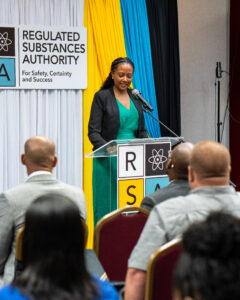
“A policy framework that legalises an economic sector while leaving it financially isolated is incomplete,” she said.
Jawahir said cannabis businesses would need the same basic financial services as other legal enterprises, including bank accounts, payroll processing, electronic transfers and access to credit.
She also argued that keeping the industry largely in cash could create the very problems banks are trying to avoid.
“An unbanked cash-intensive industry presents a far greater anti-money laundering risk than a regulated transparent and banked sector,” she said.
Government is targeting implementation of the industry in 2027, while the legislative framework is still expected to go before Parliament.