
For three days, government officials, regional leaders, reparations advocates, academics, and representatives of African and Caribbean communities and the global diaspora gathered in Barbados as the Caribbean’s reparations movement sought to translate decades of advocacy into concrete action.
The Third CARICOM Regional Conference on Reparations, held from September 17 to 19 at the Wyndham Grand Barbados Sam Lord’s Castle, brought together regional and international voices under the theme “Reparatory Justice as the Coming Enlightenment”.
The conference came at a significant point for the movement, following the adoption of a United Nations resolution in March declaring the trafficking and racialised chattel enslavement of Africans the “gravest crime against humanity”, as well as Jamaica’s recent petition to King Charles seeking legal consideration of questions surrounding slavery and Britain’s responsibility for reparatory remedy.
But while the historical case for reparations has been made repeatedly, speakers in Barbados stressed that the movement must now focus increasingly on what comes next.
‘The damage is deep’
One of the conference’s highlights was a panel discussion featuring Barbados Prime Minister Mia Mottley, who reflected on the continuing effects of slavery and colonialism and the reasons the region continues to press for reparatory justice.
“The damage is deep psychologically, economically, it is real.”
Mottley said Barbados and other Caribbean islands continue to grapple with the consequences of a period in which power was the dominant currency.
She pointed to psychological consequences that continue to shape attitudes towards work.
“We fight the consequences today of what we call the eye-servant mentality, that people only work when somebody’s over them, watching them like an overseer.”
She also pointed to longstanding consequences relating to access to land in Barbados and educational outcomes in Jamaica.
Speaking against criticism and resistance to the reparations movement, Mottley sought to make clear that the objective was not to financially ruin those being called upon to address the historical harm.
“We have no desire to bankrupt anybody, but we have a desire for justice.”
Mottley’s remarks came amid renewed international attention on the issue, including discussion of the potential legal and diplomatic avenues available to Caribbean countries.
‘We are still the most colonised part of the world’
Sir Hilary Beckles, Chairman of the CARICOM Reparations Commission, also used the conference to stress the importance of strengthening public understanding of the reparations movement while maintaining momentum around its strategy.
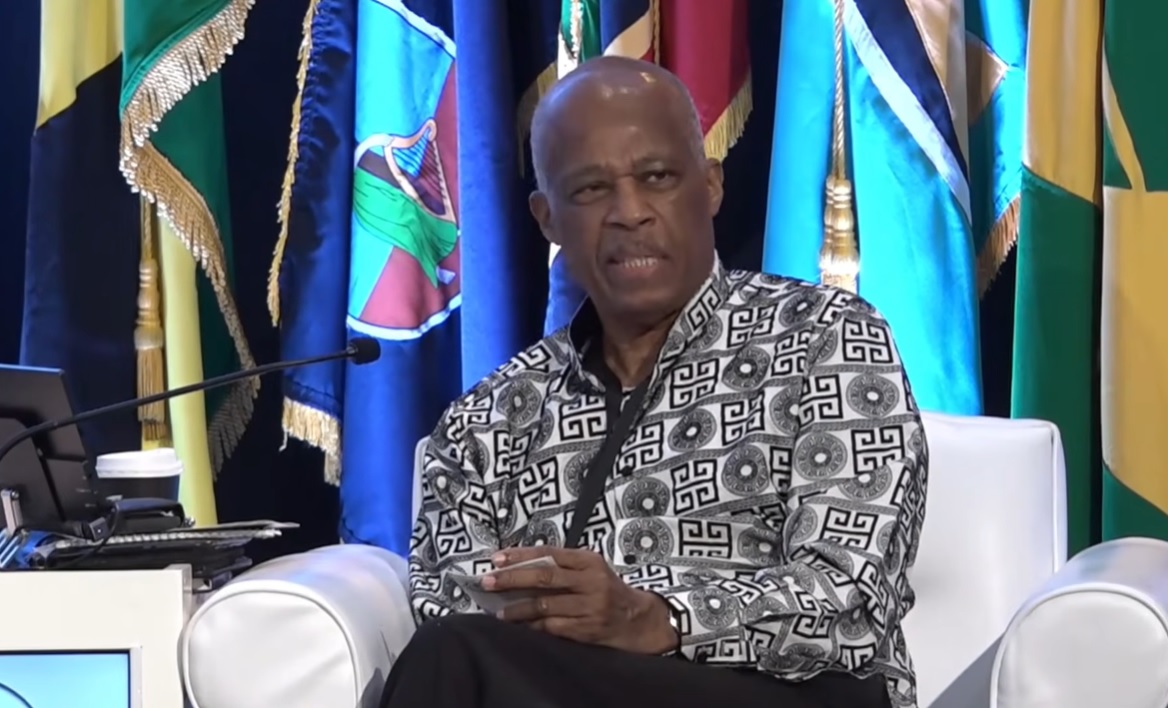
Beckles argued that the Caribbean continues to live with aspects of its colonial past.
“…We are still the most colonised part of the world. All across our archipelago we still have colonies,” he stated.
Beckles stressed that despite doubts and divisions within the movement, there was now an opportunity to advance its strategy.
“There is still some division, but we have to move with this energy source that is now before us and to… roll out the strategy; managing this moment is now the imperative.”
The renewed push comes against the backdrop of the UN resolution adopted in March. The resolution, spearheaded by Ghana, received 123 votes in favour, with three countries voting against and 52 abstaining. It calls for reparations frameworks and emphasises research, education, healing, and justice.
From dialogue to action
Conference Chairman Rodney Grant had already set out the need for a more action-oriented approach in remarks ahead of the gathering.
“We need an action-oriented outcome document that is built around the CARICOM ten-point plan, in fact, the revised CARICOM ten-point plan that speaks about the period of enlightenment,” he said.
That revised ten-point plan is central to the conference’s purpose. CARICOM says the gathering is intended to provide practical guidance on implementing the revised plan and translating the recent political and international momentum into practical legal and institutional action.
The gathering also placed emphasis on widening the movement beyond governments and reparations committees.
Regional leaders issued a call for greater public participation and urged people to add their voices to the campaign, arguing that the movement must demonstrate the strength of popular support for reparatory justice.
The message was that the next phase cannot rest solely on regional governments or established reparations bodies.