
According to local weather forecasters, rainfall in January was significantly below normal, making it the 6th driest January on record.
While some increase is predicted over the next three months, according to the Caribbean Climate Outlook Forum (CariCOF), it may not be enough to mitigate long-term drought impacts in the Windward Islands.
“In a nutshell, the position is very bleak,” WASCO’s CEO Zilta George-Leslie told reporters on Wednesday when asked to contextualise the current water situation in Saint Lucia.
“The position really is that supplies have been depleted, climate change is very active, it is taking its toll on us at this time, and a lot of our water sources are dry – our rivers are dry both in the north and in the south.”
WASCO’s responsibility, she said, was to see how best to manage the situation.
“At the end of the day, although there is no water, it’s limited in a lot of areas. Canaries and a few other systems may have but the supply is not enough for the entire Island. Our caption is ‘water is life’, so we then have to try to manage the resource, which we’re doing now.”
George-Leslie explained that they were considering valving, a process that would allow the available water supply to be distributed among different communities.
The CEO also addressed the trucking of water, explaining that it involves transporting supplies from areas of abundance to communities facing scarcity. She noted that this practice is extremely costly and adds significantly to the company’s financial burden.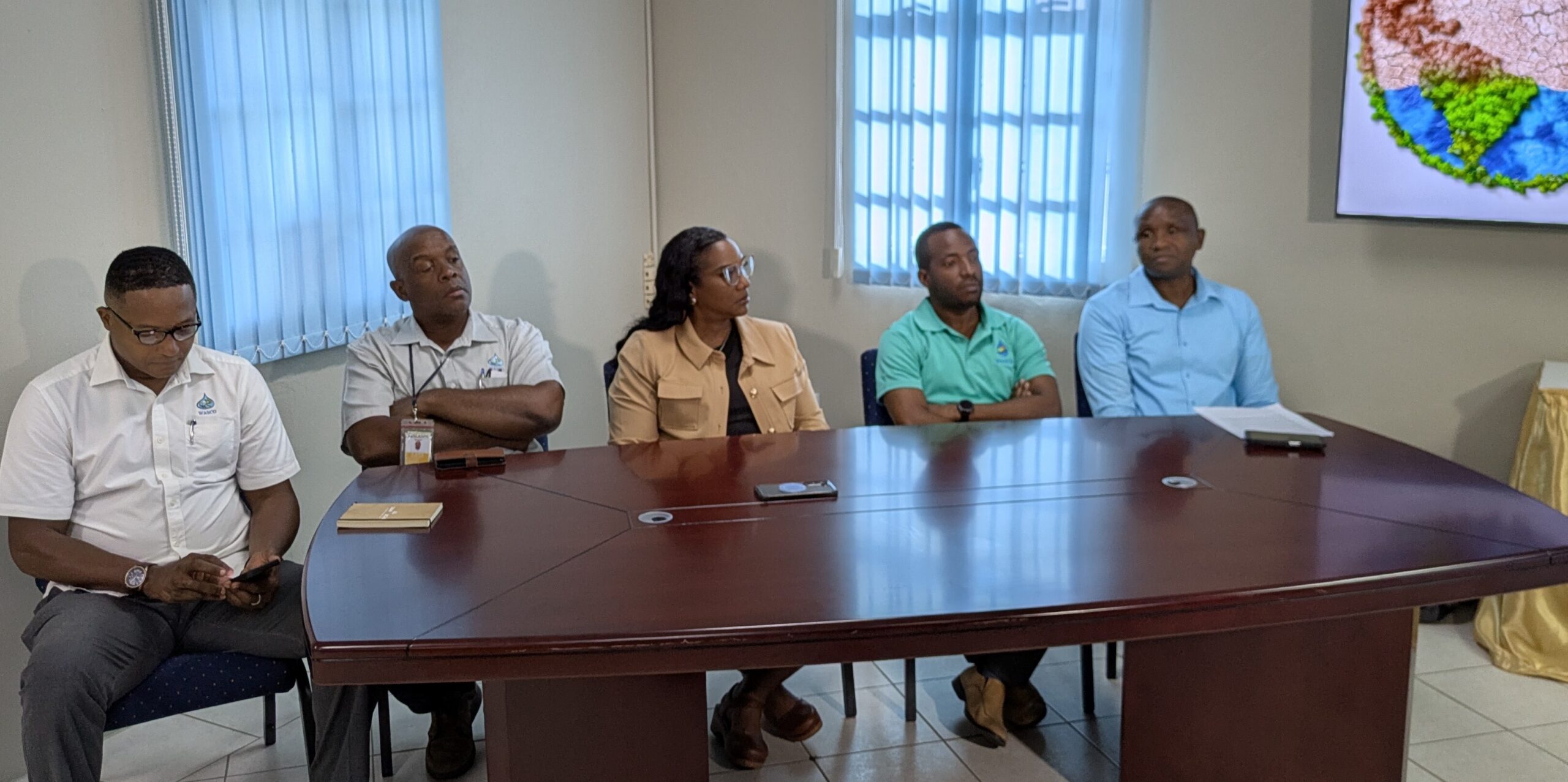
“Whereas we have our own trucks, we cannot supply the number of customers. We then have to use private truckers and that is where the cost really comes in,” George-Leslie said.
She revealed that the annual cost to WASCO runs between EC$1 million and $2 million.
“You may also appreciate that that figure could increase depending on the number of emergencies or emergency maintenance works that we have to do,” she explained.
Last week saw one such emergency where the water supply had to be shut down due to damaged pipelines. Domestic and commercial supplies were severely affected in the north, which has a high concentration of hotels.
“Thankfully, the hotels have been very cooperative. The hotels do their own private trucking, so we are able to focus. That really lifts the burden,” George-Leslie stated.
The CEO was pressed to comment on WASCO’s application for a water rate increase, which is before the National Utilities Regulatory Commission.
“All WASCO has done is submit an application to the NURC. We’re in the process of the consultation, so persons can provide feedback on what they believe should be the situation with the rate increases,” she replied.
She, however, affirmed that WASCO needs a rate increase.
Jason Ernest, director of the company’s Water Resource Management Unit, said February was critical regarding the state of water resources in the short term.
“The forecast for January-February- March was that it was going to be wetter than usual but even if it is going to be a bit wetter than usual, it all depends on the distribution of the rainfall,” he said.
Ernest explained that even after rainfall, the water supply is not necessarily restored right away.
“In most cases, if we have high water events for a number of catchments outside the John Compton Dam, the system has to be shut down because of turbidity, so it’s a very delicate system,” he said.
Jim King, who heads the Water Services Unit at WASCO, said water levels at the dam are lower than at the same period last year. Some intakes were also registering a deficit.
King noted that the dry season’s impact is felt most severely in the south of the island. He explained that because rural systems are smaller, the effects there are magnified compared to larger systems like the Compton Dam.
Coupled with the dry season, King lamented the damage to the raw water lines earlier this month. While the lines have been restored, WASCO acknowledges that major investment is required to replace its ageing infrastructure.
WASCO’s head of water projects Maurice Norville spoke to the company’s short- to medium-term interventions. “We have already commenced projects that seek to alleviate some of the pressures that we are facing as it pertains to the conditions of our infrastructure,” Norville informed the press.
WASCO has already secured funding to replace the raw lines that run from Millet to Vanard and is in the pre-construction phase of the project. Another project is the upgrade to the Theobalds treatment plant, and a third is the replacement of the northern pipeline from Bonne Terre to Gros Islet, which is expected to commence in March.
For the long term, WASCO has made a case for desalination plants, which it considers inevitable.




Have recognized this “bleakness”, what are we doing about those car washes that use potable water for washing cars?